The Journal of Community Development (Rural-Urban)

The Journal of Community Development (Rural-Urban)

The Journal of Community Development (Rural-Urban) is an Open Access journal. The aim of this journal is to publish the results of theoretical and empirical research in the field of local development. This journal follows the policies and guidelines of the Committee on Ethics (COPE) in publishing articles.


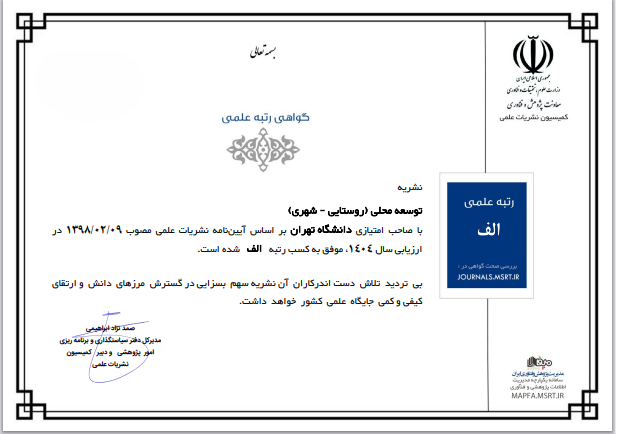
Publisher: University of Tehran Press

Publication Sequence: Two Quarterly

Publication type: Electronic

Type of Articles: Research and Review

Peer Review Policy: Double-blind peer-review

Initial Review: Average 1 week

Review and Acceptance Time:  Average 12 weeks

Acceptance rate of articles: 15%

Plagiarism: Samim Noor, Hamtajo (maximum similarity 15%)

Article Processing Charges: 11500000 Rials (Review fee 2,500,000 Rials & Publication fee 9000,000 Rials) 

COPE: The Journal of Community Development (Rural-Urban) Research follows the policies and guidelines of the Committee on Publication Ethics (COPE) and abides by its Code of Conduct in dealing with potential cases of misconduct.
Copyright: Authors retain unrestricted copyrights and publishing rights.
Type of License: CC BY-NC 4.0   

Open Access: There are no financial, legal, or technical barriers to access to articles in this journal.


A memorandum of understanding was signed between The Journal of Community Development (Rural-Urban) and the Iranian Anthropological Association.


Current Issue: Volume 18, Issue 1, June 2026 

A Sociological Study of the Feeling of Social Exclusion among Citizens of Zahedan

Pages 225-246

10.22059/jrd.2026.407254.668964

Reza Safari shali, Mohammad Osman Hosseinbar, Erfan Askani, Kobra Sadat Noori

Keywords Cloud

  • Rural Development
  • Social capital
  • Tehran
  • participation
  • Development
  • Migration
  • local development
  • Grounded theory
  • Rural
  • .
  • Iran
  • phenomenology
  • rural women
  • Community Development
  • Village
  • quality of life
  • Rural Areas
  • Kurdistan province
  • climate change
  • Women
  • Rural tourism
  • Social Exclusion
  • Tehran city
  • Qualitative Method
  • government
  • Kermanshah
  • Local Community
  • Human Development
  • Sustainable Development
  • Lived Experience
  • family
  • Resistance
  • marginalization
  • urban poverty
  • poverty
  • Empowerment
  • poverty alleviation
  • Neighborhood
  • urban space
  • environment
  • embeddedness
  • Entrepreneurship
  • Housing
  • social development
  • Water
  • sustainability
  • Agriculture
  • social participation
  • everyday life
  • Neighborhood development
  • Tourism
  • Neighborhood Management
  • pathology
  • Thematic analysis
  • social status
  • adaptation
  • NGOs
  • Governance
  • Vitality
  • Isfahan
  • Mazandaran province
  • Institutions
  • city
  • Lorestan Province
  • Communication
  • Social network analysis
  • Water Crisis
  • TEHRAN
  • Knowledge
  • Narrative Analysis
  • Crisis
  • Identity
  • Content analysis
  • Risk-taking
  • urban development
  • Drought
  • Education
  • Evaluation
  • Rural-urban linkages
  • urban public space
  • Media
  • Rural Cooperatives
  • principles of cooperation
  • Human capital
  • Kolbari
  • Islamic Councils
  • traditional neighborhoods
  • Livelihood
  • subalterns
  • Charities
  • Right to the city
  • Dam construction
  • Economic Development
  • Economic Action
  • environmental development
  • Dashtestan County
  • Spatial Analysis
  • Youth
  • Border
  • Economic Sociology
  • Sustainable Livelihood
  • Critical Ethnography
  • Rural Tourism
  • Water governance
  • Rural youth
  • Social Empowerment
  • Environmental Degradation
  • interaction
  • traditional identity
  • Rural Migration
  • modernization
  • Lifeworld
  • Hawraman
  • Rural Entrepreneurship
  • Globalization
  • Rural Community
  • Sustainable Rural Development
  • Local communities
  • South Khorasan Province
  • Rural communities
  • Informal Trade
  • rural girls
  • Regional Development
  • Social cohesion
  • Yazd
  • process of development
  • Meta-analysis
  • Cooperative
  • Social Justice
  • social change.
  • Individualism
  • Local management
  • Municipality
  • Development theory
  • Social solidarity
  • Economy
  • social security
  • discourse
  • Institution
  • Social Welfare
  • Population Dynamics
  • vulnerability
  • Democracy
  • spatial inequality
  • technology
  • farmers
  • Sanandaj
  • critical discourse analysis
  • social trust
  • Lifestyle
  • Cooperation
  • Ethnic Identity
  • Leadership
  • Informal Settlements
  • Land Fragmentation
  • employment
  • Rural Sociology
  • Land
  • Remittances
  • rural management
  • Urban Poor
  • welfare
  • performance
  • land reforms
  • Agricultural mechanization
  • Land Consolidation
  • situational analysis
  • Oil
  • convergence
  • Mashhad
  • Indigenous Knowledge
  • Life-world
  • University of Tehran
  • symbol
  • Food security
  • Inequality
  • Religion
  • Second Homes
  • Population Redistribution
  • Gender
  • Marriage
  • Decision making
  • Path analysis
  • generation gap
  • Social problems
  • Emigration
  • Self-reliance
  • age at marriage
  • Tradition
  • power
  • Economic Development
  • History of Iran
  • gender inequality
  • Celibacy
  • Rural Housing
  • subjectivity
  • Social Alienation
  • Industrial Development
  • Labor Market
  • Qajar Period