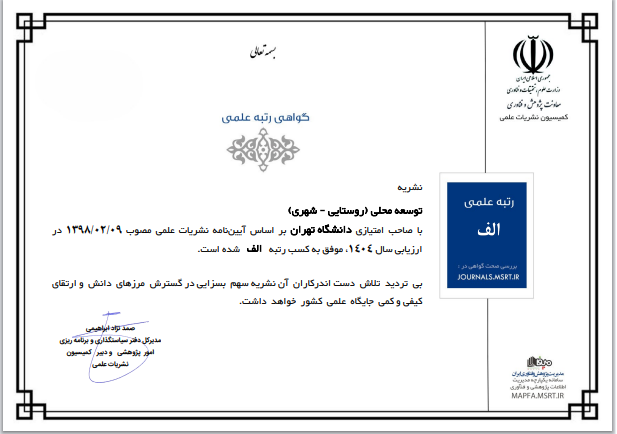
The Journal of Community Development (Rural-Urban)

The Journal of Community Development (Rural-Urban)

The Journal of Community Development (Rural-Urban) is an Open Access journal. The aim of this journal is to publish the results of theoretical and empirical research in the field of local development. This journal follows the policies and guidelines of the Committee on Ethics (COPE) in publishing articles.


Publisher: University of Tehran Press

Publication Sequence: Two Quarterly

Publication type: Electronic

Type of Articles: Research and Review

Peer Review Policy: Double-blind peer-review

Initial Review: Average 1 week

Review and Acceptance Time:  Average 12 weeks

Acceptance rate of articles: 15%

Plagiarism: Samim Noor, Hamtajo (maximum similarity 15%)

Article Processing Charges: 11500000 Rials (Review fee 2,500,000 Rials & Publication fee 9000,000 Rials) 

COPE: The Journal of Community Development (Rural-Urban) Research follows the policies and guidelines of the Committee on Publication Ethics (COPE) and abides by its Code of Conduct in dealing with potential cases of misconduct.
Copyright: Authors retain unrestricted copyrights and publishing rights.
Type of License: CC BY-NC 4.0   

Open Access: There are no financial, legal, or technical barriers to access to articles in this journal.


A memorandum of understanding was signed between The Journal of Community Development (Rural-Urban) and the Iranian Anthropological Association.


Current Issue: Volume 18, Issue 1, June 2026 

A Sociological Study of the Feeling of Social Exclusion among Citizens of Zahedan

Pages 225-246

10.22059/jrd.2026.407254.668964

Reza Safari shali, Mohammad Osman Hosseinbar, Erfan Askani, Kobra Sadat Noori

Keywords Cloud

  • Rural Development
  • Tehran
  • Social capital
  • Development
  • participation
  • local development
  • Migration
  • .
  • Rural
  • Grounded theory
  • Iran
  • phenomenology
  • Community Development
  • quality of life
  • Village
  • Women
  • Rural tourism
  • climate change
  • rural women
  • Rural Areas
  • family
  • Kurdistan province
  • Social Exclusion
  • marginalization
  • Resistance
  • Empowerment
  • Neighborhood
  • government
  • Human Development
  • Qualitative Method
  • Kermanshah
  • poverty
  • Tehran city
  • poverty alleviation
  • Sustainable Development
  • Local Community
  • urban poverty
  • Neighborhood Management
  • pathology
  • Vitality
  • city
  • social participation
  • Agriculture
  • Institutions
  • social status
  • Lived Experience
  • Tourism
  • Governance
  • Lorestan Province
  • everyday life
  • urban space
  • Neighborhood development
  • embeddedness
  • environment
  • Mazandaran province
  • Isfahan
  • adaptation
  • Entrepreneurship
  • Water
  • sustainability
  • social development
  • NGOs
  • Housing
  • Livelihood
  • Risk-taking
  • Youth
  • Human capital
  • Sanandaj
  • Yazd
  • vulnerability
  • Lifestyle
  • Rural youth
  • Regional Development
  • Institution
  • rural management
  • traditional identity
  • Narrative Analysis
  • Spatial Analysis
  • Sustainable Livelihood
  • Content analysis
  • Cooperative
  • TEHRAN
  • Thematic analysis
  • Right to the city
  • Rural Tourism
  • Social network analysis
  • Local communities
  • Economy
  • Social cohesion
  • employment
  • Drought
  • Hawraman
  • Water governance
  • Knowledge
  • Informal Trade
  • Crisis
  • Rural Entrepreneurship
  • Social solidarity
  • urban development
  • Rural Migration
  • Rural communities
  • Environmental Degradation
  • technology
  • Democracy
  • modernization
  • Local management
  • environmental development
  • Land Fragmentation
  • Ethnic Identity
  • Remittances
  • Water Crisis
  • Lifeworld
  • Rural Cooperatives
  • Rural Community
  • Cooperation
  • Social Justice
  • Meta-analysis
  • Rural Sociology
  • social change.
  • Social Welfare
  • Development theory
  • Media
  • Charities
  • Informal Settlements
  • Economic Action
  • Economic Sociology
  • Land
  • Education
  • Border
  • Dashtestan County
  • Population Dynamics
  • Globalization
  • spatial inequality
  • discourse
  • social trust
  • subalterns
  • Leadership
  • process of development
  • Critical Ethnography
  • South Khorasan Province
  • Islamic Councils
  • farmers
  • Social Empowerment
  • Dam construction
  • Economic Development
  • traditional neighborhoods
  • Individualism
  • Evaluation
  • principles of cooperation
  • social security
  • urban public space
  • rural girls
  • Sustainable Rural Development
  • Municipality
  • Urban Poor
  • Communication
  • Aq Qal
  • Zoning of flood hazard
  • Lorestan Deluge
  • Investment Barriers
  • Sustainability
  • Peripheral Areas
  • rural health
  • livelihoods sustainable
  • Social Identity
  • Qualitative study
  • cooperative awareness
  • the Role of Women
  • Right to be Different
  • Selseleh Regional Development Plan
  • Intention to Migrate from the Village
  • ROJIN-TAK Agro-Industrial Complex
  • marriage age
  • free market
  • Mashhad
  • Institutional power
  • Sustainable Development
  • Survival and Continuity Strategies
  • rural people
  • Karaj City
  • Unsustainable Development
  • Good Governance
  • Low-Carbon Approach
  • psychological homelessness
  • Poor People
  • Property Rights
  • Liberation
  • Small Cities
  • Children of Addicted Parents
  • Urban and Rural Dual Habitus
  • Indigenous Food System
  • Strategic Actions and Assessment
  • Women Migration
  • Rural Evolutions.
  • Ban
  • Out-migration
  • Rural Housing
  • Juridicalization
  • Participatory management
  • Entrepreneurial spirit